The Long-Day Dress: How to Tell in the Fitting Room If It Will Last the Reception
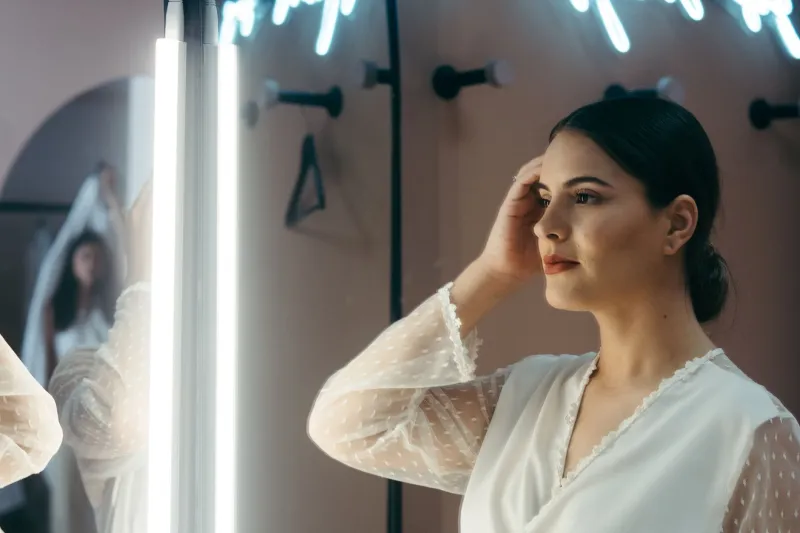
There is a particular moment in every fitting room when a dress looks excellent. You are standing still, shoulders back, mirror angled kindly. Then you sit down. For a UK wedding day, that is where the real assessment begins.
A wedding invitation rarely means one neat hour. It means a ceremony, drinks on a lawn or in a pub, a meal, speeches, perhaps a coach between venues, and dancing that goes on longer than anyone planned. Your dress has to survive all of it without needing a rescue mission in the loos. So before you fall for the hanger appeal, give it a long-day audition.
Start with the seat, not the mirror
Before you twirl, sit. Not perched on the edge of the fitting-room bench, but properly down on a chair, feet flat, back against the backrest. Stay there for a minute. Breathe out. Lean forward as if you are listening to a speech. Cross your legs. This is not about being negative; it is about finding out what the dress does when you stop posing.
Check the waistband first. It should lie flat rather than roll, dig or gape. Then the zip and any boning or seams. If they press into your ribs while you are sitting upright, they will be unbearable by the main course. Look at the neckline too: does it stay put when you relax your shoulders, or does it suddenly require constant adjustment?
The three-point fit check
A dress that passes the mirror test can still fail the day. Use three simple checks in the fitting room.
1. The seated check
Sit for at least a couple of minutes. The waist should not cut in, the skirt should not ride up to an uncomfortable place, and the bodice should feel secure without being restrictive. If the dress has a slit, check that it stays closed enough when you sit. If it has a high neckline, make sure it does not pull at the back of your neck.
2. The reach check
Stand up and reach for something above your head. Hug an imaginary guest. Stretch one arm across the table for the salt. Sleeves should not trap your arms, armholes should not cut into your underarm, and the shoulders should not lift the whole dress with them. A wedding day involves a lot of reaching: glasses, canapés, coat hooks, tissues, someone's hand.
3. The stride check
Walk across the shop in the shoes you plan to wear. Then find a stair if you can. A hem that skims the floor when you stand can become a trip hazard when you climb into a marquee or step onto a kerb. Check that you can take a normal stride, not a shuffle. If the dress has a train or a very narrow cut, make sure you can manage it without holding it up all day.
Fabrics that forgive a long day
Some fabrics look wonderful for ten minutes and tired by four o'clock. For a long UK wedding, look for materials with a bit of natural recovery. Crepe is a reliable choice because it tends to fall back into shape after sitting. Ponte and stretch tailoring are comfortable and hold their line. A lined viscose blend can feel lovely and move well, though it may crease. Matte satin with a little stretch is far more forgiving than a stiff, unforgiving version.
Be wary of anything that creases sharply across the lap after a short sit, or that catches on every sequin and chair. Linen can be beautiful for a summer wedding, but it will look relaxed very quickly. That is not a crime, but it is worth knowing before you commit. If you love a fabric that shows every mark, plan for it: choose a darker colour, carry a stain pen, and accept that the dress will look lived-in by the evening.
Cuts that earn their keep
A wrap dress is a strong candidate because it adjusts and tends to be forgiving through the waist. Fit-and-flare and A-line shapes skim rather than cling, which helps when you sit and eat. Empire lines can work well for a long meal, as long as the underbust seam is comfortable. Column dresses can be elegant, but check that the fabric has enough stretch and that there is a vent or split if the skirt is narrow.
Two-piece outfits are quietly practical too: a skirt and top can be adjusted separately, and you are less likely to feel restricted after lunch. Whatever the cut, look for room through the hips when seated and a waistband that does not need constant tugging. If the dress fits beautifully standing but strains when you sit, go up a size and have it taken in where it matters.
At-home tests before the tags come off
The fitting room is a start, but your own home is a better testing ground. Order the dress, try it on with the shoes and underwear you plan to wear, and give it a proper trial.
- The dining chair test: sit at your table for twenty minutes, then stand up and check for creases, gaping and adjustments.
- The stair test: walk up and down your stairs at a normal pace. Check the hem, slit and neckline.
- The car or coach test: sit in a passenger seat and reach for the seatbelt. This is surprisingly revealing.
- The dance test: play one song and move as you would at a reception. Raise your arms, bend your knees, turn around.
- The meal test: sit and mime cutting food, reaching across the table and leaning in to talk.
- The shoe test: wear your intended heels indoors for ten minutes. If you are already wobbling, the dress is not the problem, but you need to know.
If the dress fails one of these tests, do not assume it will loosen or that you will get used to it. Sometimes a simple alteration solves everything: shortening a hem, adding a hidden button, taking in a waist or securing a strap. Budget for that before you decide the dress is too expensive. A good alteration is often cheaper than replacing the whole outfit.
The dress you forget about
The best wedding guest dress is not the one that demands attention all day. It is the one you stop thinking about by the time the speeches begin. You can eat, sit, stand, chat and dance without a running mental checklist. At Loulou Boutique, the new-arrival rails are full of occasion-ready pieces, but the real test happens away from the mirror. Give a dress a chair, a staircase and a song before the tags come off. If it passes, you can relax and enjoy the day.